The pipeline does not cost 25 billion dollars: it costs men
N. Cherfaoui — Oran, Algérie & Y. Bensalem — Alger, Algérie — 2026-10-18
The Atlantic project is announced at 25 billion dollars. That is the price of the pipe. What is missing is the heaviest line — and the only one no press release puts a figure on: the engineers, the schools, the sea equipment, the maintenance.
A pipe can be bought. An engineer must be trained.
1. The engineers: how many, and who has them?
How many engineers does a 6,800-kilometre gas pipeline need? The honest answer is: “not established”. No public document of the Atlantic project gives a headcount — neither for construction nor for operation.
The only comparable public data concerns the maintenance of a European section: the Albanian section of TAP (Trans Adriatic Pipeline) and the Albanian domestic network employ 45 to 60 people — and those staff were trained in Italy (Xinhua, 12 June 2018). And that is maintenance only: the construction of a pipeline mobilises far larger welding, laying, control and engineering teams. The Atlantic project would cross twelve transit states and an occupied territory, with no documented common operator — and no public document says how many engineers would have to be trained, or by whom.
What the states would have to provide, however, can be broken down: project engineers, certified welders, pipeline-integrity technicians, compressor- and metering-station operators, regulators. And an engineer is not trained on a construction site: the cycle counts in years — five, generally. A project that must train its engineers before delivering gas is therefore not to be judged on the timetable of a construction schedule.
2. The schools: four exist, for thirteen states
| School | Country | What it is | Source |
|---|---|---|---|
| PTDF — Petroleum Technology Development Fund | Nigeria | “Nigeria's foremost petroleum human-capital development institution”; trains graduates, professionals and technicians | ptdf.gov.ng |
| IAP — Algerian Petroleum Institute | Algeria | State petroleum training school, founded in 1965 | dossier 036 of the editorial team; public notice |
| AOGC | Ghana | Training institution created in November 2017, to strengthen Ghanaians' capacity to work in the petroleum sector | Ghana Ministry of Finance, 2021 Annual Petroleum Report |
| INPG — National Oil and Gas Institute | Senegal | National training institute (date of creation not established) | inpgsenegal.com |
Of the thirteen states, only four have a documented gas-training school. For the other nine — Benin, Togo, Côte d'Ivoire, Liberia, Sierra Leone, Guinea, Guinea-Bissau, Gambia, Mauritania — the search finds nothing. ⚠️ The absence of a source is not an absence of competence: several already train technicians. But in a 25-billion-dollar project, a documentary gap is an unquantified risk.
These four schools are not interchangeable. Nigeria's PTDF presents itself as a national tool with a stated regional ambition (“a human-resources centre for the West African sub-region”). The IAP has trained Algerian technical cadres since 1965. Ghana's AOGC, created in 2017, is the most recent: it aims at Ghanaians' capacity to work in the sector. Senegal's INPG is a national institute. None of these four schools is documented as training the engineers of the other eleven states — and none replaces twelve regulators. This is not a criticism: it is an inventory.
These four schools are not interchangeable. Nigeria's PTDF presents itself as a national tool with a stated regional ambition (“a human-resources centre for the West African sub-region”). The IAP has trained Algeria's technical cadres since 1965 — and it also trains foreign engineers: an academic cooperation agreement links it to the Congolese national oil company (SNPC), and it takes part in the APPO Forum of training institutions. The IAP does not content itself with training Algerians: it signed, on 12 February 2026, a training convention with Senegal's INPG — and it therefore already trains cadres for one of the transit states of the Atlantic project. This is experience that counts: it shows that Algeria has what the Atlantic project is looking for. Ghana's AOGC, created in 2017, is the most recent: it aims at Ghanaians' capacity to work in the sector. Senegal's INPG is a national institute. None of these four schools replaces twelve regulators. This is not a criticism: it is an inventory: four schools exist, and nine states on the list have none.
| State | Documented gas-training school | Documented gas regulator | Estimated needs for its section |
|---|---|---|---|
| Nigeria | yes — PTDF | not established | not established |
| Benin | not established | not established | not established |
| Togo | not established | not established | not established |
| Ghana | yes — AOGC (2017) | not established | not established |
| Côte d'Ivoire | not established | not established | not established |
| Liberia | not established | not established | not established |
| Sierra Leone | not established | not established | not established |
| Guinea | not established | not established | not established |
| Guinea-Bissau | not established | not established | not established |
| Gambia | not established | not established | not established |
| Senegal | yes — INPG | not established | not established |
| Mauritania | not established | not established | not established |
| Morocco | not established | not established | not established |
| Western Sahara (Non-Self-Governing Territory) | not established | not established — a Non-Self-Governing Territory has no regulator | not established |
This table does not say “they do not know”: it says “the public sources do not say”. And it asks a simple question: who will train the teams of eleven states where no gas school is documented?
4. Sea equipment: who owns the ships and the robots?
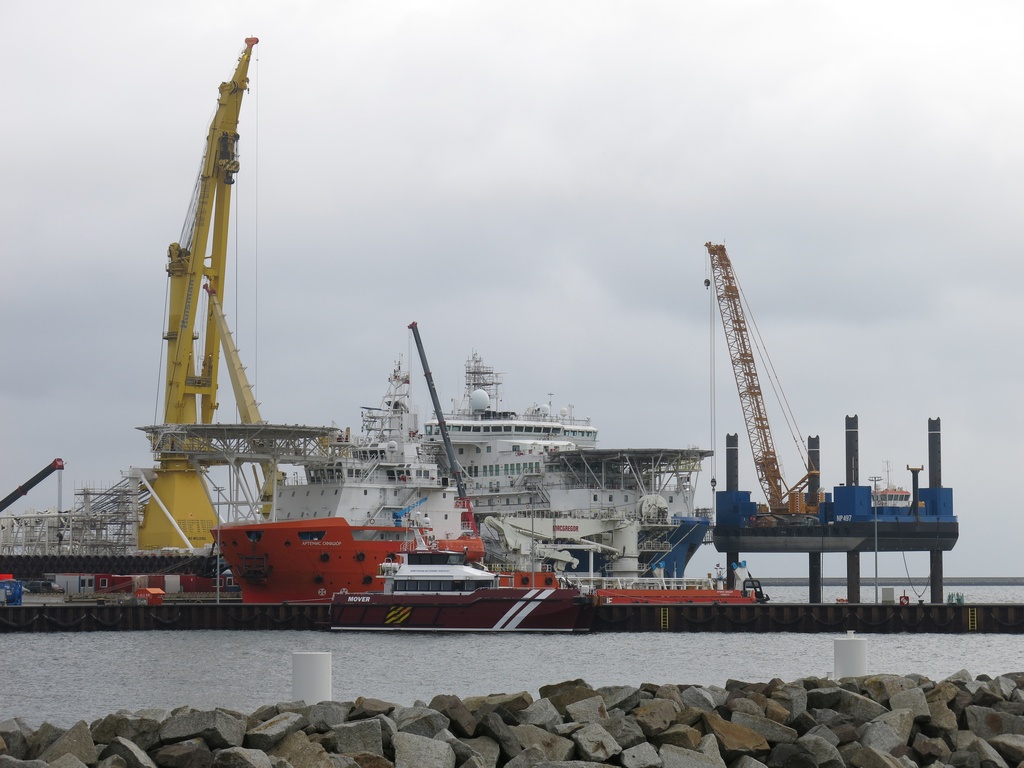
A subsea gas pipeline is not built with trucks. It requires laying barges, maintenance vessels, ROVs — remotely operated underwater vehicles — for inspection.
These tools are not rented like a car: they are rented with their crews, their certifications and their operators. In the industry they belong to specialised contractors who move them from site to site. How many of these items belong to the thirteen states? No public source says: “not established”. The most telling comparison is Algeria's own : in September 2025, Sonatrach signed two pipeline-inspection contracts with a consortium of Chinese companies (CAIEC and SLPI) (APS, September 2025). The country with the most gas experience in Africa entrusts the inspection of its pipelines to foreigners. That is not a weakness: it is the reality of specialisation. But then, who will inspect the 6,800 kilometres of the Atlantic project?
5. Maintenance: the cost nobody counts
Maintaining a TAP section in Albania costs 4 to 6 million euros a year at first, and up to 10 to 15 million later (Xinhua, 2018). That cost is not borne by Albania alone: a joint venture had to be created with the Italian operator Snam, because, according to the Albanian energy minister, “the country did not have the experience”. The staff — 45 to 60 people — were trained in Italy. And maintenance does not stop at pipes: it requires local bases, on-call teams, inspection robots and spare parts. For a 6,800-kilometre route, that means dozens of intervention sites to equip and keep in working order. Who will pay for them? No public document says. And who will train the teams? For TAP, the answer is documented: Italy.
6. The cost — or the absence of cost
None of the figures that matter is published : the number of engineers needed, the number of schools to create, the cost of training, the equipment, the maintenance budget per state, the skills ramp-up timetable. An unquantified cost is not a zero cost.
| What is missing from the public record | What the sources say |
|---|---|
| The number of engineers needed | not established — neither for construction nor for operation |
| The number of schools to create | not established — four schools exist, nine states have nothing documented |
| The cost of training | not established — no published budget line |
| Sea equipment (barges, ROVs, vessels) | not established — no public inventory for the thirteen states |
| The maintenance budget per state | not established — the only comparable is the Albanian TAP |
| The skills ramp-up timetable | not established — no date for the availability of the teams |
The only documented model — TAP — says this: a transit state needs a foreign partner and trains its teams abroad. For a project that crosses twelve transit states and an occupied territory, that means twelve dependencies — and one question with no answer: who pays?
A pipe can be bought. An engineer must be trained. A project that must train its engineers before delivering gas cannot be judged over ten years: it must be judged over a generation.
The full dossier: [Perfidy, parody: the mirage of the 15 billion m³ — but the real SWINDLE is the profits pocketed](/en/article/le-maroc-ne-consomme-pas-le-gaz-il-le-revend) · The economic note: [The gas is not flowing yet. But the billions, Morocco has already counted them.](/en/article/les-benefices-du-gaz-un-seul-pays-les-encaisse-le-maroc)
N. Cherfaoui — Oran, Algeria · Y. Bensalem — Algiers, Algeria
📚 FULL BIBLIOGRAPHY (rule 19)
1. Xinhua (en), “Albanian, Italian companies sign agreement on joint venture establishment for TAP maintenance”, 12 June 2018 — joint venture Albgaz (75%)–Snam (25%) for the maintenance of TAP in Albania; 45 to 60 employees, trained in Italy; “the country did not have the experience” (Albanian energy minister); initial cost of 4 to 6 million euros a year, up to 10 to 15 million — https://www.xinhuanet.com/english/2018-06/12/c_137249517.htm
2. TubeChina, “Snam, Albgaz form JV to maintain TAP pipeline” — details of the 75%/25% joint venture, 45 to 60 people, initial services at 4 to 6 million euros a year, maintenance of the Albanian domestic network included — https://www.tubechina.net/en/news/info/997.html?mid=37
3. APS (Algérie Presse Service), “Sonatrach signe deux contrats d'inspection de pipelines avec un consortium chinois”, September 2025 — two inspection contracts signed in Algiers with the CAIEC–SLPI consortium — https://www.aps.dz/fr/economie/industrieenergie-et-mines/mfzv3own-sonatrach-signe-deux-contrats-d-inspection-de-pipelines-avec-un-consortium-chinois
4. PTDF — Petroleum Technology Development Fund (Nigeria), official “About us” page — “Nigeria's foremost petroleum human-capital development institution”; trains graduates, professionals, technicians; ambition to make Nigeria “a human-resources centre for the West African sub-region and the Gulf of Guinea” — https://ptdf.gov.ng/about-us/
5. Ghana Ministry of Finance, 2021 Annual Petroleum Report — the AOGC was created in November 2017, to strengthen Ghanaians' capacity to work in the petroleum sector — https://www.mofep.gov.gh/sites/default/files/reports/petroleum/2021-Annual-Petroleum-Report.pdf
6. INPG Senegal — National Oil and Gas Institute, official site — existence of the training institute (date of creation not established) — https://inpgsenegal.com/
7. Algerian Petroleum Institute (IAP) — public notice: school specialising in the petroleum and hydrocarbons trades, founded in 1965; the exact date (29 November 1965) is the one retained by the editorial team's dossier 036 — https://fr.wikipedia.org/wiki/Institut_alg%C3%A9rien_du_p%C3%A9trole
8. Trans Adriatic Pipeline (TAP) — official site — TAP links Greece, Albania, the Adriatic and Italy; with TANAP and the SCPX it forms the Southern Gas Corridor — https://www.tap-ag.com/
9. Algeria Vanguard dossier AV-R-20261016-053 — announced length of the Atlantic project (6,800 to 6,900 km), cost (~25 billion dollars), thirteen states, 30 Gm³/year; detailed sources in its bibliography — [Perfidy, parody: the mirage of the 15 billion m³ — but the real SWINDLE is the profits pocketed](/en/article/le-maroc-ne-consomme-pas-le-gaz-il-le-revend)
10. Sonatrach (official site), “Signing of an agreement between the Algerian Petroleum Institute and the Congolese company SNPC, as well as a contract between the IAP and the University of Boumerdès” — academic cooperation agreement between the IAP and the Congolese national oil company (SNPC): the IAP also trains foreign engineers — https://sonatrach.com/en/signing-of-an-agreement-between-the-algerian-petroleum-institute-and-the-congolese-company-snpc-as-well-as-a-contract-between-the-iap-and-the-university-of-boumerdes/
11. APPO — African Petroleum Producers' Organization (official page), “What you need to know about the APPO Forum of Directors of Oil and Gas Training Institutes” — Forum of training institutions of APPO member countries, in which the IAP takes part — https://apposecretariat.org/what-you-need-to-know-about-the-appo-forum-of-directors-of-oil-and-gas-training-institutes-ce-que-vous-devez-savoir-sur-le-forum-des-directeurs-dinstituts-de-formation-dans-le-secteur-petrolier-e/
12. Radio Algérienne (fr), « Signature d'un accord de coopération académique entre l'Institut Algérien du Pétrole (IAP) relevant de Sonatrach et une entreprise congolaise » — academic cooperation IAP–SNPC — https://newsmedia.radioalgerie.dz/fr/node/40168
13. TSA — Tout sur l'Algérie, « L'Algérie va former les cadres du secteur pétrolier du Sénégal » — training convention IAP–INPG Senegal, 12 February 2026 — https://www.tsa-algerie.com/lalgerie-va-former-les-cadres-du-secteur-petrolier-du-senegal/
14. Le Jeune Indépendant, « Algérie-Sénégal : renforcement de la coopération dans les hydrocarbures et l'électricité » — training convention between the IAP and Senegal's INPG, one of the transit states of the Atlantic project — https://www.jeune-independant.net/algerie-senegal-renforcement-de-la-cooperation-dans-les-hydrocarbures-et-lelectricite/
⚠️ Published reservations.
(1) No public data on the workforce the Atlantic project would need. Neither construction nor operation: “not established”. We invent no headcount figure.
(2) The TAP comparison is a comparison, not a projection. 45 to 60 people for the maintenance of the Albanian section of TAP and the Albanian domestic network: that figure accounts neither for the desert, nor for the depths, nor for the twelve transit states. We do not extrapolate it to derive a headcount: no headcount projection is published.
(3) TAP maintenance costs concern the Albanian section and its domestic network. They are not transferable as such to a 6,800-km subsea pipeline. “Several hundred million dollars a year” is a proportion, not a budget.
(4) “Documented school” means “public source found” — not “absent capacity”. The absence of a source is not an absence of competence; several states already train technicians.
(5) The Sonatrach–CAIEC/SLPI contracts cover pipeline inspection, not general maintenance. They prove dependence on a foreign provider for a specialised service — not incapacity.
(6) No public data on the ownership of ROVs, maintenance vessels or barges by the thirteen states. “Not established” — and that is itself information: in a 25-billion-dollar project, nobody says who owns the tools.
(7) No public data on the financing of training or maintenance by state. Who will pay? The question has no documented answer.